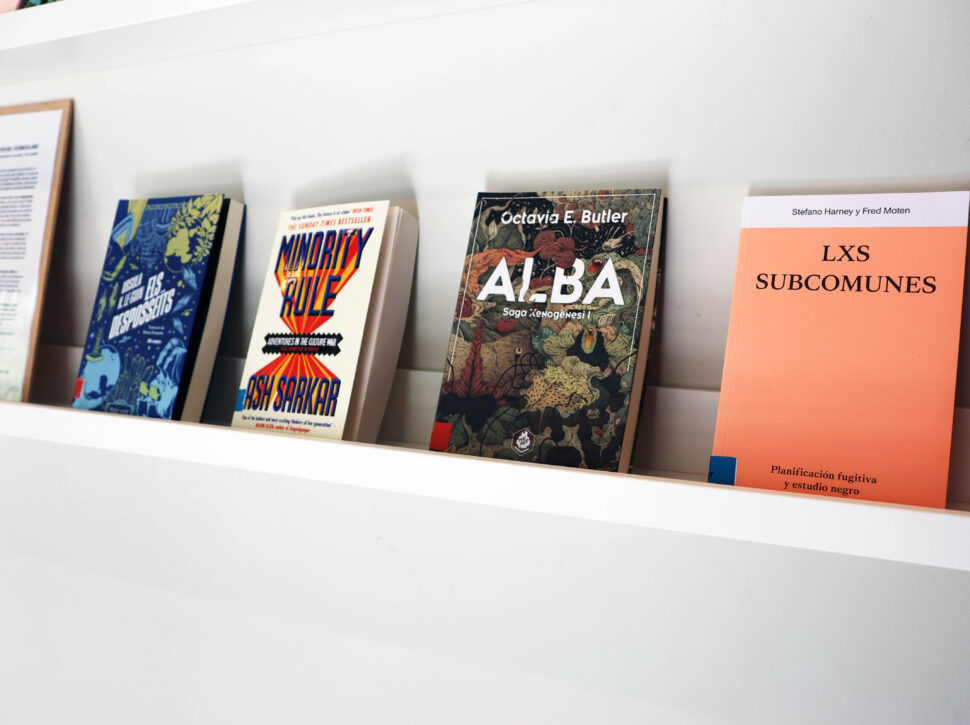
I think there is something very intimate about sharing what one reads, almost like sharing what one writes. It is a way of revealing who we are in conversation with or, as Sara Lewis Capellari once put it to a group I was part of, as a way of introducing ourselves: who do we go to bed with? I have decided, then, to respond to Raquel’s invitation to choose two books that are not yet in the El Graner library and two others that are already part of it, by taking a kind of “snapshot” of who I have been in conversation with lately.
I will begin with the two books that will travel from my own library to Graner’s. The first title is The Dispossessed, by Ursula K. Le Guin. A classic both of the author and of the science fiction genre, and deservedly so. The story takes place on two planets: Urras and Anarres. The former is a wealthy capitalist planet divided into several nations; the latter is an arid planet with scarce resources, inhabited by an anarchist society that exiled itself from Urras after a revolution. Shevek, the protagonist, is an Anarresti scientist who travels to Urras to complete his theory of time and ends up entangled in a series of political conflicts. It is a beautiful novel through which to think and speculate about the different effects these two political systems produce in their populations.
The second title is Minority Rule, by the British Marxist journalist and political commentator Ash Sarkar. Although the book is strongly focused on the British context, it clearly and accessibly explains how the political class and the media instrumentalize identity politics. They do so by promoting the idea of a culture war and the notion that we are currently living under a “dictatorship of minorities,” in order to divide people and prevent a social majority from recognizing itself as a class and organizing to challenge the real minority that determines its material conditions of life. I was particularly interested in the beginning of the book because of its critique and provocation directed at the left itself.
Among the books already in Graner’s library, I would start with Dawn, by Octavia Butler, the first title in her Xenogenesis trilogy. A science fiction novel that follows Lilith, a human woman abducted from Earth’s apocalypse by members of the Oankali species, who want her help in preparing the new human community that will repopulate a rehabilitated Earth. It is a fascinating book about gender, sex, and race, written in an accessible and captivating prose. A reading experience that made me very happy and invited me into another world.
Finally, I chose The Undercommons: Fugitive Planning & Black Study, by Fred Moten and Stefano Harney. This book, which Josefa Pereira brought to the Matilha study group that we are carrying out together with Bibi Dória and Andrei Bessa, has confronted us with questions and ideas that challenge hegemonic ways of understanding education, study, and collective thought. It is a book I have only partially read so far, but one that is worth mentioning here because I will undoubtedly devote more attention to it.
Thank you for this invitation, as simple as it is thought-provoking, which has given me a tremendous desire to get to know Graner’s library in person. I would love to talk about these books with anyone interested.
Resident artist at El Graner 2026 with the project “Si la profundidad estuviera en la superficie” in the international category.
Bibliographic References:
1. K Le Guin, Ursula. Els desposseïts. Editorial Raig Verd, 2024.
2. Sarkar, Ash. Minority Rule: Adventures in the Culture War. Bloomsbury Publishing, 2025.
3. Butler, Octavia. Alba. Editorial Mai Més, 2024.
4. Moten, Fred & Harney, Stefano. Lxs Subcomunes: planificación fugitiva y estudio negro. IF Publications, 2024.
Read more
Read less