Mireia de Querol is an artist, teacher and mediator of Graner’s educational programme.
When I was asked to curate this fantastic shelf, with an educational focus, I felt quite daunted, since the term “educational” has so many implications and resonances. A responsibility reverberates in it, a character of critical thinking, but also constructive, applied, active, political, emotional… All at once. It touches me and makes me tremble a little.
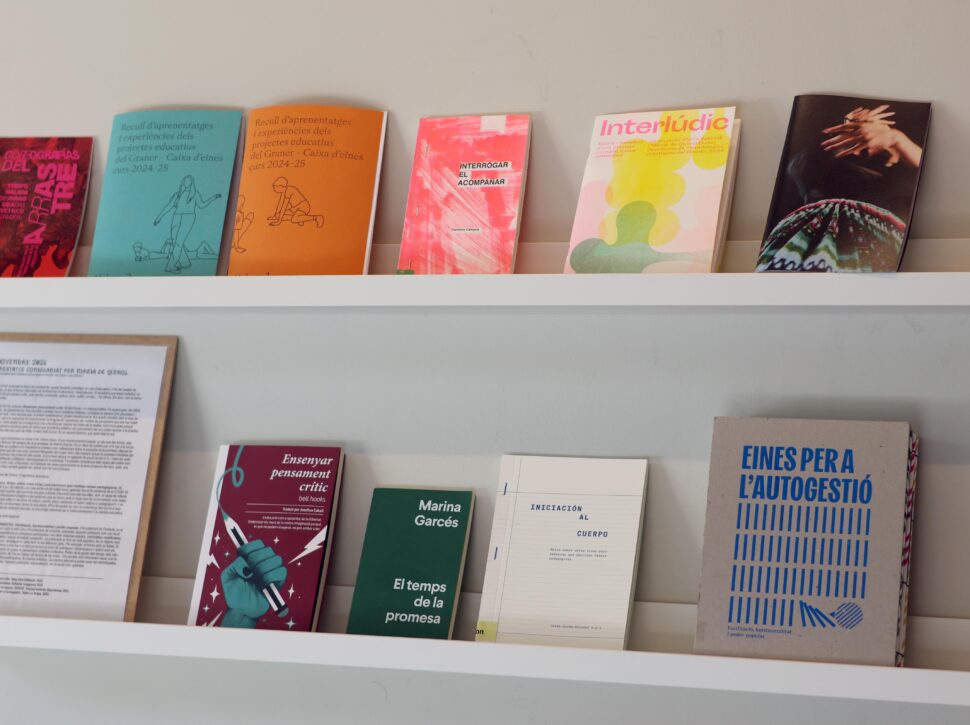
Well, first of all, I suggest Teaching Critical Thinking by bell hooks. An essential. It makes that gesture, so difficult at times, of questioning oneself. It invites us to review ourselves and the way we perceive and understand the world, and reminds us that if we can question it, we can transform it. I especially hold on to bell hooks’s idea about the need to decolonise the imagination and question the models of thought that have been handed down to us. She also speaks of imagination as a tool for expanding the limits of reality. I love this because this thinking connects with the values that artistic practice and knowledge of the body can bring to educational practice. From my point of view, it is very close to it. It is a fighting spirit, which is so needed right now.
Another book that recently fell into my hands, quite by chance, one rainy day while strolling through a bookshop: El temps de la promesa (The Time of the Promise), by Marina Garcés. It is such a tiny book that it fits in my bum bag. I find the way it reflects on the concept of the promise both poetic and unsettling, firing off in different directions that paint a raw, piercing picture of our world and the present moment: the unlimited promise of capitalism, the promise of protection by states, the promise versus the predictive capacity of AI, and all the philosophical, political and psychological qualities and drifts of the promise. It makes you aware of the challenges of our world and makes me think about how important it is to accompany new generations in their projection of the future, when, right now, being able to imagine a future seems almost as bold as making a promise.
Going through Graner’s library, I would like to recommend:
Iniciación al cuerpo. Notas sobre artes vivas para personas que realizan tareas pedagógicas (Initiation to the Body: Notes on Live Arts for People Doing Pedagogical Work), by Jaime Conde-Salazar s.u.s. It is described as a collection of short notes, conceived during the COVID-19 pandemic. I found it a lovely exercise that combines a guide through simple bodily actions with a space for reflection that activates questions aimed directly at people who face the daily challenge of transmission in the classroom. For example: «¿Para qué utilizo o me sirve mi cuerpo cuando estoy realizando mi labor creativa o pedagógica?» (“What do I use my body for, or what is it useful for, when I am doing my creative or pedagogical work?”). And I wouldn’t want to give any more spoilers: I recommend taking a look. It made me think about how awareness of the body in its space within everyday life is truly a jewel, an essential anchor for self-knowledge and educational practice.
And, to finish, a very special project:
TOOLS FOR SELF-MANAGEMENT. Facilitation, Horizontality and Popular Power, by Arquitectura de Contacte, as part of their project “Com està el pati”. Arquitectura de Contacte presents this publication as “a collection of resources born from experience in participatory processes, which aims to offer practical, printable and modifiable materials to facilitate assemblies, workshops and shared workspaces”. The physical publication is very playful; it is a fascinating object to hold in your hands, unfolding it and discovering its different parts. For example, you come across a leaflet, El cau dels recursos (The Den of Resources), which very generously synthesises a host of practices and dynamics relating to participatory processes and the management of groups of collective thought and practice. They talk about managing time, roles and speaking styles, emotions, the use of space, the time for care… I find it very interesting to see how the practice of activism and participatory politics, artistic practice and educational practice can be so intertwined and so close to one another. This publication, especially, makes me feel more optimistic.
Bibliographic references:
1. hooks, bell. Ensenyar pensament crític. Raig Verd Editorial, 2022.
2. Garcés, Marina. El temps de la promesa. Editorial Anagrama 2023.
3. Conde-Salazar, Jaime. Iniciación al cuerpo. SUDOR. Transpiraciones discursivas, 2023.
4. Arquitectura de contacte.Eines per a l’autogestió. Taller La Grapa, 2025.
Read more
Read less