Before starting the stimulating task of choosing four titles from the Graner collection (2 from inside and 2 from outside its library), I went for a walk around the website and revisited the titles chosen by my colleagues who came before me: Joaquín, Lautaro, Reinaldo, and Lu.
Luckily, some of my favorites had just been selected to be highlighted in the library, which opened the way for me to look elsewhere on the shelves. My exercise was to try to look at many temporalities at once, searching for titles that have accompanied me for a long time and others that have just arrived — and this has nothing to do with the chronological time of their publication.
The order will follow my encounter with each book, respecting the subjective timeline of my experience.
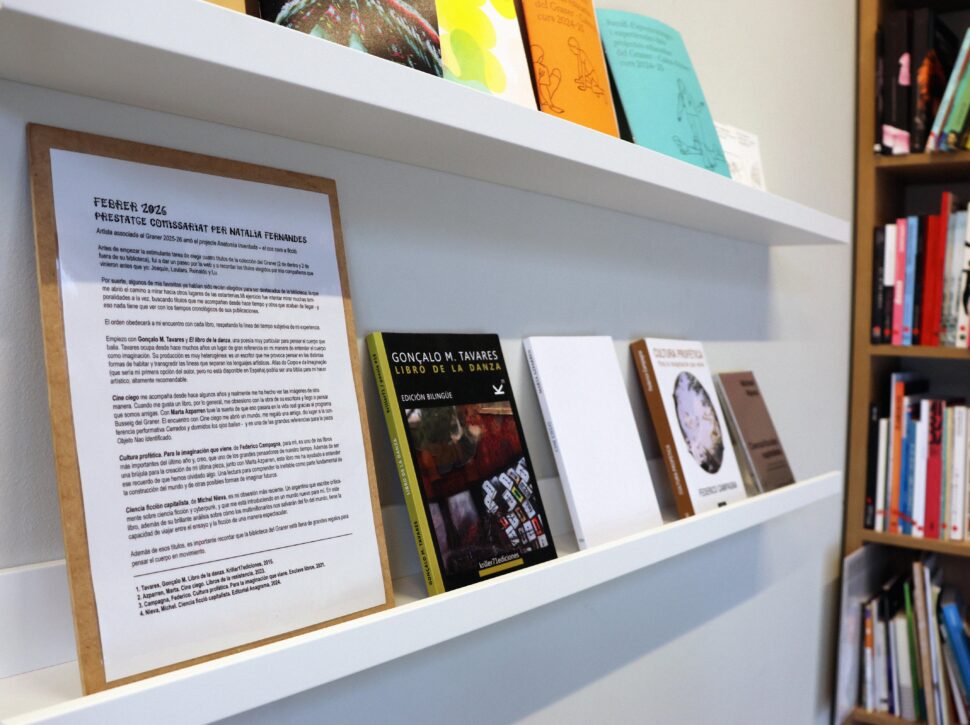
I begin with Gonçalo M. Tavares and The Book of Dance, a very particular kind of poetry for thinking about the dancing body. Tavares has occupied, for many years now, a place of great importance in my way of understanding the body as imagination. His production is highly heterogeneous: he is a writer who pushes me to think about different ways of inhabiting and transgressing the lines that separate artistic languages. Atlas do Corpo e da Imaginação (which would be my first choice by this author, but is not available in Spain) could be a bible for my artistic practice; highly recommended.
Cine ciego has accompanied me for several years and has truly made me see images in a different way. When I like a book, I usually become obsessed with the author’s work and even start to think that we are friends. With Marta Azparren I was lucky enough for that to happen in real life thanks to Graner’s Busseig program. Encountering Cine ciego opened up a world for me, gave me a friend, gave rise to the performative lecture Cerrados y dormidos los ojos bailan, and is one of the main references for the piece Objeto Nao Identificado.
Prophetic Culture: For the Imagination to Come, by Federico Campagna, is, for me, one of the most important books of the past year and, I believe, by one of the great thinkers of our time. In addition to being a compass for the creation of my latest piece, together with Marta Azparren, this book has helped me understand that feeling of remembering that we have forgotten something. A reading that helps us understand the ineffable as a fundamental part of the construction of the world and of other possible ways of imagining futures.
Capitalist Science Fiction, by Michel Nieva, is my most recent obsession. An Argentine writer who critically explores science fiction and cyberpunk, and who is introducing me to a world that is new to me. In this book, in addition to his brilliant analysis of how billionaires will save us from the end of the world, he has the ability to move between essay and fiction in a spectacular way.
Beyond these titles, it is important to remember that the Graner library is full of great gifts for thinking about the body in motion.
Associated artist at Graner 2025–26 with the project Invented Anatomy – the Body as Fiction.
Bibliographic References:
1. Tavares, Gonçalo M. Libro de la danza. Kriller17ediciones, 2015.
2. Azparren, Marta. Cine ciego. Libros de la resistencia, 2023.
3. Campagna, Federico. Cultura profética. Para la imaginación que viene. Enclave libros, 2021.
4. Nieva, Michel. Ciencia ficció capitalista. Editorial Anagrama, 2024.
Read more
Read less